Numb, tingling fingers that wake you at night? How to tell if it is carpal tunnel syndrome, what helps, and where splints, physio and surgery fit in.
You wake at 3am with your hand "asleep". You shake it, and the pins and needles in your thumb and first two fingers slowly fade. During the day it happens again while you hold your phone, drive, or grip a coffee cup. Lately you have started dropping things.
That pattern is the classic story of carpal tunnel syndrome (CTS), the most common nerve compression problem in the body. It is very treatable, especially when it is caught early, and many people improve without ever needing surgery. This guide explains what is going on, how it is diagnosed, which treatments actually have evidence behind them, and when it is time to see a physio or a surgeon.
At a glance
- What it is: pressure on the median nerve as it passes through a narrow tunnel at the front of the wrist
- Classic symptoms: tingling, numbness or burning in the thumb, index, middle and half of the ring finger, often worse at night
- How common: in a Swedish population study, about 1 in 7 adults reported typical symptoms and close to 3% had it confirmed on nerve testing
- Who: more often women, people aged 40–60, and in pregnancy, diabetes, an underactive thyroid and rheumatoid arthritis
- What helps: night splints, activity changes and hand therapy for mild to moderate cases; surgery when it is severe or not improving
- Warning sign: constant numbness or a shrinking thumb muscle — get it assessed promptly
What is carpal tunnel syndrome?
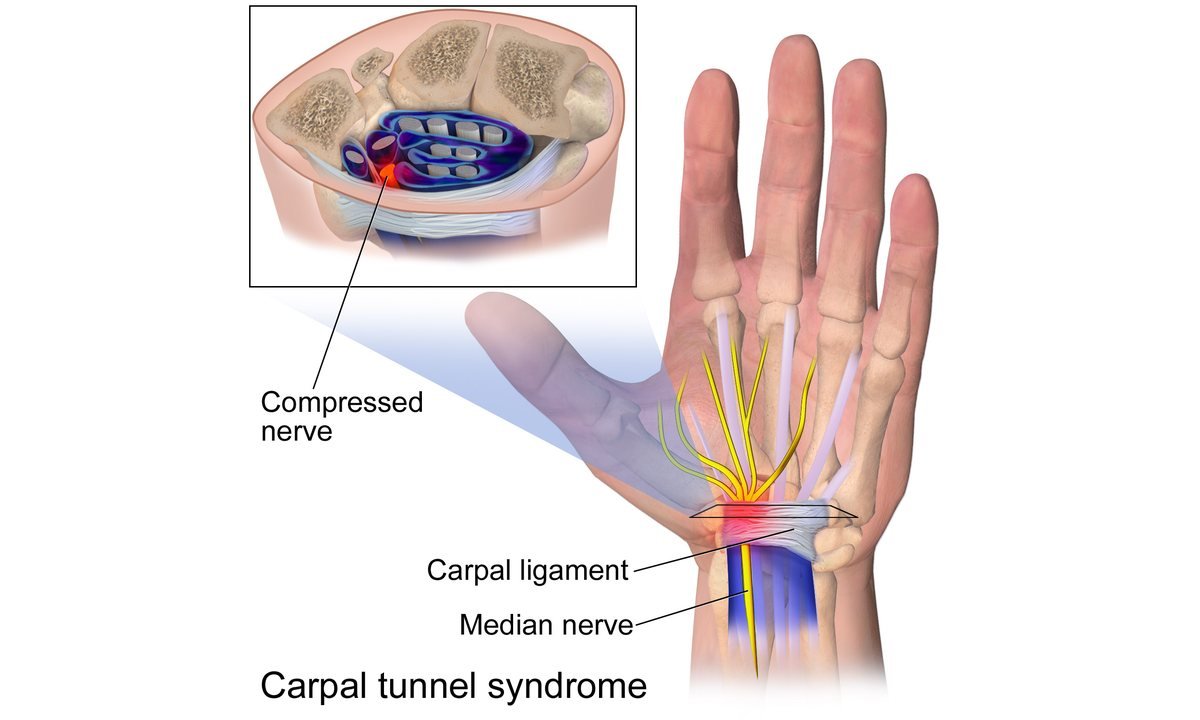
At the front of your wrist, the small wrist bones form a "U" shape. A tough band of tissue, the transverse carpal ligament, closes over the top of it to make a tunnel. Through that tunnel run nine tendons that bend your fingers and thumb — and one nerve, the median nerve.
The median nerve carries feeling from the thumb side of your hand and controls some of the small muscles that move your thumb. The tunnel has very little spare room. Anything that takes up more space inside it, or that raises the pressure in it, squeezes the nerve. Nerves do not like being squeezed: first they tingle, then they go numb, and if the pressure continues for long enough they start to lose function.
Why does it happen?
Often there is no single cause. Things that make it more likely include:
- Being female — probably partly because of a smaller tunnel
- Pregnancy — fluid retention raises the pressure in the tunnel; it often settles after the baby is born
- Diabetes, an underactive thyroid and rheumatoid arthritis
- Higher body weight
- Work with forceful, repetitive gripping or vibrating tools — trades, factory and processing work
- A previous wrist fracture or arthritis that changes the shape of the tunnel
Keyboard and mouse use is often blamed. The link with ordinary office computer work is weaker than most people think, although awkward sustained wrist positions can certainly aggravate symptoms that are already there.
Symptoms: how do you know it is carpal tunnel?
Typical features, described in a review in The Lancet Neurology and in physiotherapy clinical guidelines:
- Tingling, pins and needles or numbness in the thumb, index finger, middle finger and the thumb-side half of the ring finger
- The little finger is spared, because a different nerve supplies it
- Worse at night or first thing in the morning, often waking you
- Shaking or "flicking" the hand brings relief
- Symptoms during sustained grips — holding a phone, a book, a steering wheel or a hairdryer
- Later: clumsiness, dropping things, trouble with buttons, and weakness pinching between thumb and fingers
- In long-standing cases, wasting of the fleshy muscle at the base of the thumb
“Waking at night with tingling in the thumb and first two fingers, and shaking the hand to get rid of it, is the story we hear most. The little finger feeling normal is an important clue.”
— UpPlus Physiotherapy team
Could it be something else?
Several conditions mimic carpal tunnel syndrome, and telling them apart matters because the treatment is different:
- A pinched nerve in the neck (cervical radiculopathy) can cause arm and hand tingling, usually with neck pain. Read our guide to neck pain that runs down your arm.
- Cubital tunnel syndrome affects the ulnar nerve at the elbow and causes tingling in the little and ring fingers. See cubital tunnel syndrome.
- De Quervain's tenosynovitis causes pain, not tingling, on the thumb side of the wrist. See De Quervain's.
- Thumb base arthritis causes aching at the base of the thumb with gripping.
- Peripheral neuropathy, for example from diabetes, usually affects both hands and feet in a "glove and stocking" pattern.
How is carpal tunnel syndrome diagnosed?
Diagnosis starts with your story and a hands-on examination. A physiotherapist or doctor will typically:
- Ask you to mark where the tingling is on a hand diagram
- Test feeling in each finger and the strength of the thumb muscles
- Use provocation tests — for example holding the wrist bent (Phalen's test) or pressing over the tunnel — to see whether your symptoms are reproduced
- Check your neck and elbow to rule out a problem further up the nerve
Nerve conduction studies measure how well signals travel along the nerve. They are not always needed when the picture is clear, but they are useful when the diagnosis is uncertain, when symptoms are severe, and before surgery. Your GP can arrange them.
Treatment: what actually works?
Treatment depends on how severe and how long-standing the compression is. Broadly, mild to moderate carpal tunnel syndrome is treated without surgery first, and severe or persistent cases are referred for surgery.
1. Night splints
When you sleep, you tend to curl your wrists, which raises the pressure in the tunnel. A wrist splint that holds the wrist straight overnight is one of the simplest and most commonly recommended treatments. A Cochrane review found that the evidence for splinting is limited in quality, but that a night splint may improve symptoms in the short term compared with no treatment. In practice it is low-risk, cheap and often the first thing that gives people a full night's sleep again.
A good splint keeps the wrist straight, not bent back. Many off-the-shelf "carpal tunnel braces" hold the wrist cocked upwards, which is not ideal — a physio can check yours or fit one.
2. Changing how you load the hand
- Take frequent short breaks from sustained gripping
- Keep the wrist close to straight when typing, using a phone or using tools
- Use a thicker grip on tools and pens so you do not need to squeeze as hard
- Swap hands and vary tasks where you can
- Avoid sleeping on the hand or with the wrist tucked under you
3. Hand therapy: nerve and tendon gliding, and manual therapy
Physiotherapy for carpal tunnel syndrome commonly includes nerve gliding and tendon gliding exercises, which move the median nerve and finger tendons gently through the tunnel, along with hands-on treatment of the wrist, hand and neck.
The research is mixed and the studies are small. A Cochrane review of exercise and mobilisation found only limited, low-quality evidence. But one randomised trial in women with carpal tunnel syndrome found that a short course of manual physical therapy (including nerve and soft-tissue techniques) gave similar results to surgery at one year, and better results in the first few months. And a US trial comparing surgery with a non-surgical programme of hand therapy found that, while surgery came out somewhat ahead at a year, many people in the non-surgical group improved too.
The honest summary: for mild to moderate carpal tunnel syndrome, a well-structured course of hand therapy is a reasonable first step, and it does not stop you having surgery later if you need it.
4. Steroid injections
A corticosteroid injection into the carpal tunnel, given by a doctor, can reduce symptoms. A Cochrane review found clearer improvement at one month compared with a placebo injection, but less certainty about benefit beyond that. Some people get lasting relief; for others the symptoms return. An injection can also be a useful test: if it helps a lot, surgery is more likely to help as well.
5. Surgery
Carpal tunnel release divides the ligament over the tunnel to give the nerve more room. It is one of the most commonly performed hand operations and is usually done as a day procedure. It is recommended when:
- Numbness is constant rather than coming and going
- There is weakness or wasting of the thumb muscles
- Nerve tests show severe compression
- Symptoms have not improved after a few months of well-done conservative treatment
After surgery, physiotherapy helps with scar management, swelling, finger and wrist movement, and a graded return to gripping and work.
What about pregnancy?
Carpal tunnel symptoms are common in the second half of pregnancy and frequently settle within weeks to months after birth. Night splints, activity changes and hand therapy are the mainstay, and surgery is rarely needed during pregnancy.
Exercises you can try at home
These are gentle and should not increase your tingling. If they do, ease off and get assessed.
Tendon glides
Starting with fingers straight, move slowly through five positions: straight fingers, a "hook" (bend only the top two finger joints), a flat fist (bend at the knuckles with fingers straight), a full fist, and a "tabletop" (bend at the knuckles, fingertips touching the palm). Hold each for 3 seconds. Repeat 5 times, two or three times a day.
Median nerve glide
Make a fist with the wrist straight. Open the fingers and thumb, then slowly bend the wrist back, turn the palm up, and gently stretch the thumb out to the side. Hold briefly, then return. Move slowly, within comfort, 5 repetitions. This is about gently moving the nerve, not stretching it hard.
Thumb and grip strength
Once tingling is settling, a physio may add light thumb and pinch strengthening using putty or a soft ball, to restore grip.
Myths about carpal tunnel
- "It's from too much typing." Office keyboard work is a weaker risk than most people think. Forceful gripping, vibration, pregnancy and health conditions matter more.
- "You always need surgery." Many people with mild to moderate symptoms improve with splints and hand therapy.
- "Waiting doesn't matter." Constant numbness and muscle wasting are signs the nerve is struggling. At that stage, delaying surgery can affect how well the nerve recovers.
- "A tight brace all day is best." Night splinting is the main evidence-based use. All-day bracing can stiffen the hand.
When to see a physio
Book an assessment if:
- Tingling is waking you more than occasionally
- Symptoms are spreading or lasting longer
- You are dropping things or struggling with fine tasks
- You are not sure whether it is your wrist, your elbow or your neck
- You have been told you may need surgery and want to try conservative treatment first, or want rehab after surgery
See a doctor promptly if numbness is constant, the thumb muscle is visibly wasting, or symptoms came on suddenly after an injury.
What we do at UpPlus Physiotherapy
- A full assessment of the wrist, hand, elbow and neck to confirm where the nerve is being irritated
- Splint advice and fitting, so the wrist is held in the right position overnight
- Hands-on treatment and a home programme of nerve and tendon glides
- Workstation, tool and grip advice, including for work-related hand problems
- Clear advice on when a GP review, nerve tests or a surgical opinion makes sense
- Rehab after carpal tunnel release surgery
Read more about carpal tunnel syndrome and our manual therapy and exercise rehabilitation.
Finding a physio near me for carpal tunnel
If you are searching for the best physio for carpal tunnel syndrome, look for one who examines the whole length of the nerve (not just the wrist), explains your options honestly — including when surgery is the better choice — and gives you exercises and splint advice you can use at home.
Our clinic is at 177 Trimmer Parade, Seaton, close to Woodville, Findon, Grange, Henley Beach and West Lakes. No referral is needed, and with private health cover you can claim on the spot.
Physio take-home message
- Night-time tingling in the thumb and first two fingers is the classic sign; the little finger is usually spared.
- Start simple: a straight-wrist night splint, fewer sustained grips, and regular breaks.
- Hand therapy with nerve and tendon glides is a reasonable first step for mild to moderate cases.
- Don't wait on warning signs: constant numbness or thumb muscle wasting needs prompt medical review.
- Surgery works well when it is needed, and rehab afterwards speeds the return to full grip.
If tingling hands are interrupting your sleep or your work, our physiotherapists can assess you and set out a clear plan. Book online or call 0403 907 587.
This article is general information, not a diagnosis or a substitute for an individual assessment. If you are unsure about your symptoms, see a health professional.