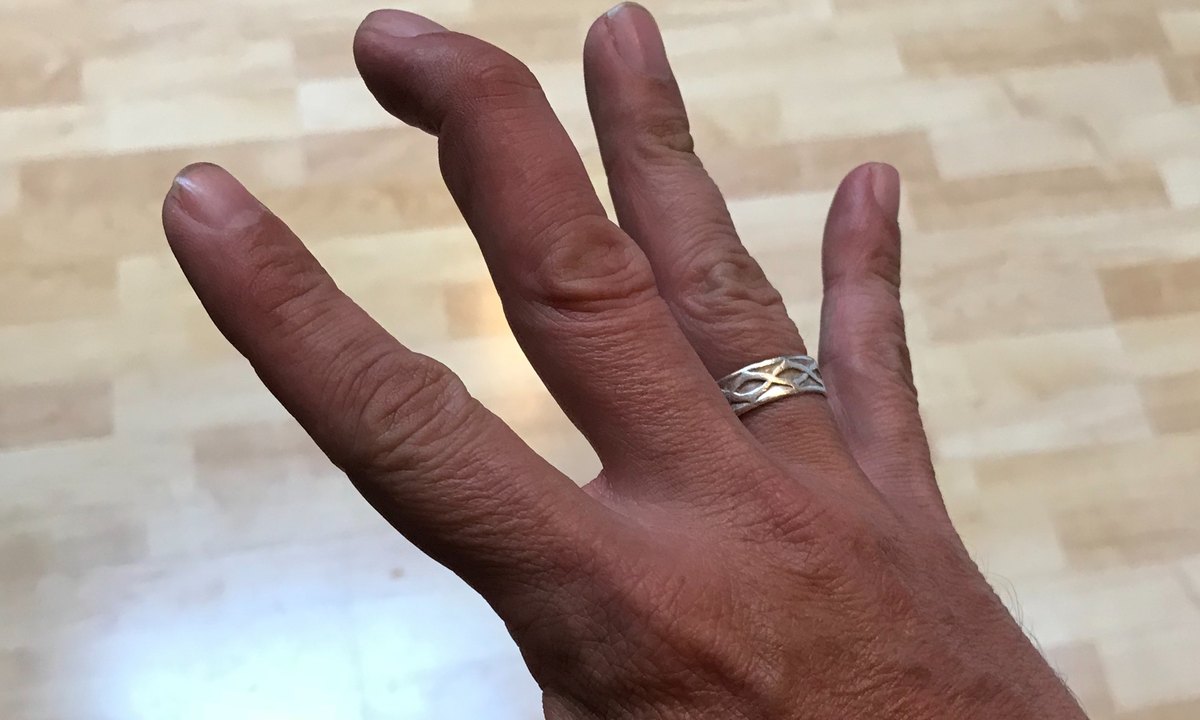
The tip of your finger has dropped and will not straighten on its own? That is usually a mallet finger. Here is what has happened, why a splint worn the right way fixes most of them, and when it needs a doctor the same day.
It often happens in a second. A ball hits the end of your finger, you jam it on a door, or you tuck in a bed sheet and feel something give. Afterwards the last joint of the finger hangs bent. You can push it straight with your other hand, but as soon as you let go it drops again.
That is a mallet finger, sometimes called baseball finger or drop finger. It is one of the most common finger injuries, and the good news is that most mallet fingers heal well without surgery, as long as the splint is worn properly and for long enough.
At a glance
- What it is: the tendon that straightens the tip of the finger has torn or pulled off a small piece of bone
- The sign: the fingertip droops and you cannot straighten it yourself, although someone else can
- Usual treatment: a splint holding the tip straight, worn full time for 6 to 8 weeks
- The key to success: the tip must not bend at all during the full-time splint period
- Surgery: kept for larger fractures, a joint that has slipped, or when a splint has not worked
- Get it checked: within a few days, with an X-ray to look for a fracture
What is a mallet finger?
The tip of each finger is straightened by a thin, flat tendon that runs along the back of the finger and attaches to the base of the last bone. In a mallet finger, that tendon is cut, torn or stretched, or it pulls off a small fragment of bone where it attaches (a bony mallet).
Once the tendon is no longer connected, nothing pulls the tip straight, so it rests bent. Nothing is wrong with the muscles; the connection is broken.
Orthopaedic reviews describe several types, depending on whether the skin is broken and whether there is a fracture. The type matters because it changes the treatment.
Tendon-only (soft tissue) mallet
The tendon itself has torn or stretched. This is the most common type, and it is usually treated with a splint.
Bony mallet
The tendon has pulled off a chip of bone. Small fragments are usually splinted too. A large fragment, or one where the joint has started to slip out of line, is when surgery is more likely to be discussed.
Open mallet
The tendon has been cut, for example by a knife or glass. This needs a doctor the same day, because the wound itself needs care and the tendon may need repair.
Symptoms
- The last joint of the finger is bent and you cannot straighten it on your own
- Someone else can straighten it gently, but it drops again when they let go
- Pain, swelling or bruising over the back of the last joint, especially early on
- Sometimes surprisingly little pain, which is why some people leave it for weeks
How it is diagnosed
The diagnosis is usually obvious from looking at the finger and testing whether you can lift the tip. An X-ray is still important, because it shows whether a piece of bone has come away, how big it is, and whether the joint is sitting in line. That decides whether a splint alone is likely to be enough.
If you have a mallet finger, try to have it assessed within a few days. Even if you notice it late, do not assume it is too late to treat. Get it checked rather than leaving it.
Treatment: the splint does the work
For most mallet fingers, the treatment is a splint that holds the last joint straight, or very slightly bent backwards, so the two ends of the tendon (or the bone chip) can heal together.
A widely cited orthopaedic review describes splinting the last joint for 6 to 8 weeks as giving good results for most people, with surgery kept for those who have not improved with splinting, cannot work with a splint on, or have a fracture involving more than about a third of the joint surface.
The one rule that matters most
During the full-time splint period, the tip must not be allowed to bend, even once. The healing tendon is fragile, and letting the tip drop can pull it apart again. That includes when you take the splint off to wash the finger or check the skin.
To clean the finger or change the splint safely:
- Rest the hand flat on a table, palm down, so the finger stays straight
- Slide the splint off while keeping the fingertip pressed flat against the table
- Wash and dry the finger, check the skin, then slide the splint back on, still flat
Your physio or hand therapist will show you how to do this and how often. If the tip does bend by accident, let your clinician know rather than ignoring it.
Which splint is best?
There are several kinds: the off-the-shelf plastic "Stack" splint, a padded aluminium splint taped along the back of the finger, and a custom thermoplastic splint moulded to your finger.
A Cochrane review of the trials found not enough evidence to say any one splint type is clearly better, but it stressed two things: the splint has to be robust enough for everyday life, and sticking to the instructions is central to success.
An Australian randomised trial compared the three splint types for acute mallet finger, worn continuously for 8 weeks and then weaned over 4 weeks. The amount of droop left at the end was similar between splints, but the custom thermoplastic splint had no treatment failures, compared with almost one in four failures with the Stack and dorsal splints. People who wore their splint more faithfully had better results.
In practice, the best splint is one that fits well, stays on, does not rub the skin, and that you will actually wear day and night.
Weaning off the splint
After the full-time period, the splint is usually worn at night and during risky activities for a few more weeks while you start gentle bending exercises. Your clinician will check that the tip stays straight as you increase how much you use it.
Surgery
Surgery, usually with a small wire or fixation of the bone fragment, is generally considered when:
- A large fragment of the joint surface has broken off
- The joint has slipped out of line
- Splinting has not worked
- Work or daily life makes wearing a splint impossible
A systematic review of 44 studies found that both surgical and non-surgical treatment gave excellent outcomes on average, with similar small amounts of droop left over and similar complication rates. The authors concluded the choice should be individualised to the person, because the evidence does not clearly favour one approach for most injuries.
Comparing the options
| Option | Best suited to | What to expect |
|---|---|---|
| Splint, full time 6 to 8 weeks | Most tendon-only and small bony mallets | Good results for most people if worn without a break |
| Custom-made splint | Skin problems with a standard splint, or a hard-to-fit finger | Fewer failures in one Australian trial |
| Surgery | Large fractures, a slipped joint, failed splinting | Similar overall outcomes in reviews; wound and wire care needed |
What happens if it is not treated?
Some people never get a mallet finger treated and live with a slightly droopy tip. For others, the imbalance in the finger can gradually pull the middle joint the other way, into a "swan-neck" shape, which is harder to fix later. A droopy tip can also catch on pockets and gloves. Treating it early gives the best chance of a straight, comfortable finger.
Everyday tips while you wear the splint
- Keep the splint dry where you can; a glove or bag helps in the shower
- Check the skin over the back of the joint each day; pale, white or broken skin means the splint is too tight
- Keep the other joints of the finger moving so they do not stiffen
- Avoid sport that could knock the finger until your clinician clears you
- Do not trim or adjust the splint yourself; ask for a refit instead
Myths about mallet finger
- "It does not hurt much, so it is not serious." The pain is often mild, but the tendon is still disconnected.
- "I can take the splint off for a shower." Only if you keep the tip straight on a flat surface the whole time.
- "Six weeks is up, so I am finished." Most protocols include a weaning period; stopping suddenly can let the tip drop again.
- "It is too late to treat." Even late injuries are often still worth assessing.
When to see a doctor or physio
See your GP, an emergency department or a hand clinic the same day if:
- There is a cut over the back of the finger joint
- The nail is lifted, or blood is coming from under the nail, especially in a child
- The finger looks crooked, or you cannot move the other joints
For a drooping fingertip without a wound, book an assessment within a few days so the finger can be X-rayed and splinted early.
How UpPlus Physiotherapy helps
At UpPlus Physiotherapy in Seaton, our physiotherapists can assess a mallet finger, arrange or review an X-ray, fit a splint that holds the tip in the right position, and teach you how to care for the skin without letting the tip bend. We check the finger through the healing period, guide the weaning and exercises afterwards, and refer you to a hand surgeon if the injury needs it.
Read more about other hand problems: trigger finger, wrist sprain and carpal tunnel syndrome.
Finding a physio near me for mallet finger
Look for someone who checks for a fracture, fits a splint that holds the right joint without rubbing, explains exactly how to keep the tip straight, and follows you through the whole healing period rather than handing you a splint once.
Our clinic is at 177 Trimmer Parade, Seaton, a short drive from Woodville, Findon, West Lakes, Grange and Henley Beach.
Physio take-home message
- A drooping fingertip after a knock is usually a mallet finger.
- An X-ray checks for a fracture and guides treatment.
- A splint worn full time for 6 to 8 weeks fixes most of them.
- The tip must stay straight the whole time, even when the splint is off for cleaning.
- A cut, a lifted nail or a crooked finger needs medical care the same day.
If your fingertip has dropped, our physiotherapists can assess it and get it splinted properly. Book online or call 0403 907 587.
This article is general information, not a diagnosis or a substitute for an individual assessment. If you are unsure about your symptoms, see a health professional.