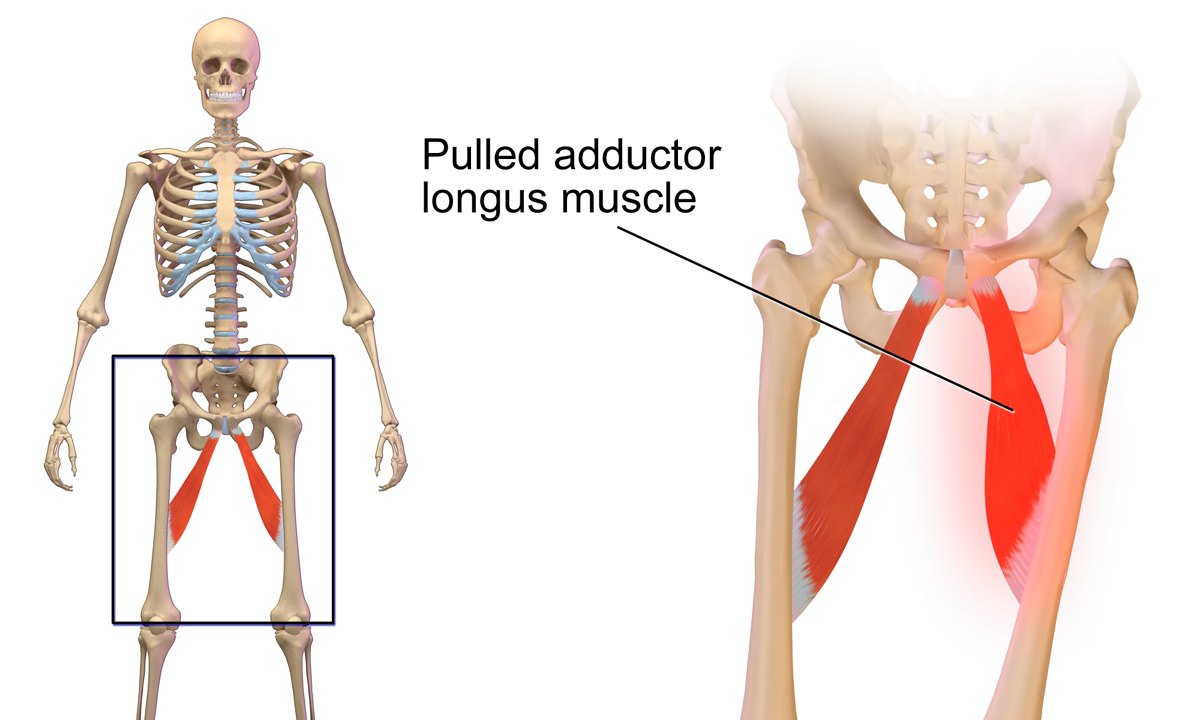
A sharp pain in the inner thigh or groin while kicking, sprinting or changing direction? That is often an adductor strain. Here is how long it usually takes, what the research says about rehab, and the simple exercise that cuts the risk of it happening again.
The adductors are the group of muscles on the inside of your thigh. They pull the leg inwards, steady the pelvis, and work hard every time you kick a ball, push off sideways or stop suddenly. That is why a "pulled groin" is so common in soccer, Australian rules football, hockey and other sports with kicking and quick changes of direction.
You may hear it called a groin sprain, but a muscle is strained while a ligament is sprained, so the accurate term is an adductor strain. Whatever you call it, the good news is that most adductor strains recover well with a structured exercise program.
At a glance
- What it is: a strain or tear of the inner-thigh (adductor) muscles, most often adductor longus
- Common causes: kicking, sprinting, sliding, sudden sideways movements
- Symptoms: inner-thigh or groin pain, worse squeezing the legs together
- Typical recovery: about 2 to 3 weeks for most strains, around 3 months for a complete tear
- Treatment: a criteria-based strengthening program, not just rest
- Prevention: adductor strengthening, such as the Copenhagen exercise, reduces groin problems
The adductor muscles
The adductor group includes adductor longus, adductor brevis, adductor magnus, pectineus and gracilis. They run from the front of the pelvis, near the pubic bone, down the inside of the thigh. Adductor longus is the one most often strained, usually near where it attaches at the pelvis or where muscle meets tendon.
Groin pain is not always the adductors
To cut through confusing terms, international experts meeting in Doha agreed a simple classification of groin pain in athletes:
- Adductor-related groin pain: tender over the adductors, with pain when you squeeze the legs together against resistance
- Iliopsoas-related: pain at the front of the hip from the hip flexor
- Inguinal-related: pain around the inguinal canal, without a hernia you can feel
- Pubic-related: pain over the pubic bone joint
- Hip-related groin pain: coming from the hip joint itself
- Other causes, which a clinician needs to keep in mind
This article focuses on the acute adductor strain, the sudden injury. Long-standing groin pain is discussed further below.
Symptoms
- A sudden pain or "pull" in the groin or inner thigh during sport
- Pain squeezing your knees together, or pushing a ball between them
- Pain kicking, changing direction, sprinting or getting out of a car
- Tenderness along the inner thigh or near the pubic bone
- Bruising on the inner thigh a day or two later with a larger tear
How it is diagnosed
A physio or doctor diagnoses most adductor strains by examination: finding the tender spot, testing squeeze strength, checking how far the leg moves out to the side, and ruling out the hip, hernia and other causes. An MRI is sometimes used in elite sport or if a complete tear is suspected, but most people do not need one to start rehab.
How long does an adductor strain take?
One of the most useful studies followed 81 male athletes through a structured, criteria-based rehab program after an acute adductor injury, with each injury graded on MRI from 0 (no visible damage) to 3 (complete tear or the tendon pulled off the bone).
| Injury on MRI | Pain-free (median) | Back to full team training (median) |
|---|---|---|
| Grades 0 to 2 (most strains) | 13 days | 18 days |
| Grade 3 (complete tear or avulsion) | 55 days | 78 days |
So most strains took around 2 to 3 weeks, and complete tears around 3 months. Re-injury within a year was 8% overall. Importantly, athletes who reached the "clinically pain-free" milestone during rehab had far fewer re-injuries than those who did not (5% versus 21%).
A follow-up analysis of the same group found that flexibility returned to normal early, while adductor strength kept improving through rehab, and that no single test could pinpoint the exact moment someone was ready. That is why a good return-to-sport decision combines several checks, not one.
Treatment: a strength program, step by step
The first few days
- Avoid kicking, sprinting and sideways movements that cause sharp pain
- Keep walking within comfort
- Start gentle squeezes (isometrics) early if they are not painful
Building strength
- Isometric squeeze: a ball or folded pillow between the knees, squeeze gently and hold, gradually harder
- Side-lying adduction: lying on your side, lift the bottom leg towards the ceiling
- Sliding or lateral lunges: controlled sideways movements, small range first
- Copenhagen adduction exercise: a side plank with the top leg supported on a bench; start with the knee supported (short lever) before progressing
Back to running and sport
- Straight-line running, then faster running
- Change-of-direction drills and cutting
- Passing, then kicking, short then long
- Full training before matches
Long-standing groin pain: exercise works
When adductor-related groin pain has dragged on for months, exercise is still the mainstay. A landmark randomised trial in The Lancet compared an active training program, focused on strength and coordination of the muscles around the pelvis and especially the adductors, with physiotherapy treatment that did not include active training, in athletes whose groin pain had lasted a median of 40 weeks. After treatment, 23 athletes in the active training group returned to sport without groin pain, compared with 4 in the other group.
Prevention: the Copenhagen adduction exercise
Adductor weakness is a known risk factor for groin injury, and strengthening helps prevent it.
- In a cluster-randomised trial of 35 semi-professional Norwegian football teams, an Adductor Strengthening Programme built on just one exercise, the Copenhagen adduction, done 3 times a week in pre-season and once a week during the season, lowered the season-long prevalence of groin problems from 21.3% to 13.5%, a 41% lower risk.
- In a professional ice hockey team, players identified as having weak adductors did a 6-week strengthening program, and adductor strains fell from 11 in the two seasons before to 3 in the two seasons after.
For anyone who plays a kicking or change-of-direction sport, a few sets of adductor strengthening a week is a small investment.
Myths about groin strains
- "Just stretch it out." Flexibility comes back early; strength is what takes time and protects against re-injury.
- "Play through it." Athletes who never reached the pain-free stage had more re-injuries.
- "Rest for six weeks." Most strains recover faster with a structured program than with rest alone.
When to see a physio or doctor
See a physio for a groin strain that stops you running or kicking, keeps coming back, or has lasted more than a couple of weeks.
See a doctor promptly if:
- You felt a pop with immediate, severe pain and large bruising, which may be a complete tear
- There is a lump in the groin, especially one that changes with coughing
- You have testicular pain or swelling (seek care urgently)
- Groin pain comes with fever, feeling unwell, or pain that does not ease at rest
How UpPlus Physiotherapy helps
At UpPlus Physiotherapy in Seaton, our physiotherapists assess where the groin pain is coming from, then build a staged program: early pain-free loading, progressive adductor and hip strengthening including the Copenhagen exercise, running and change-of-direction drills, and clear criteria before you return to training and matches. We also help teams and players add adductor strengthening to their warm-ups to reduce the risk of future strains.
Read more about groin strain, hip impingement and hamstring strain.
Finding a physio near me for a groin strain
Look for a physio who tests squeeze strength and tracks it, progresses you through clear stages, and uses objective checks before you return to sport, rather than simply telling you to rest.
Our clinic is at 177 Trimmer Parade, Seaton, a short drive from Woodville, Findon, West Lakes, Grange and Henley Beach.
Physio take-home message
- Most adductor strains take around 2 to 3 weeks with structured rehab; complete tears around 3 months.
- Getting fully pain-free during rehab is linked to fewer re-injuries.
- Strength is the key measure, not flexibility.
- The Copenhagen adduction exercise helps prevent groin problems.
- A lump, testicular pain or a sudden pop with big bruising needs a doctor.
If a groin strain is keeping you off the field, our physiotherapists can assess it and plan your return. Book online or call 0403 907 587.
This article is general information, not a diagnosis or a substitute for an individual assessment. If you are unsure about your symptoms, see a health professional.